tamarjacobson

Looking back and thinking forward

Month: July, 2017

Pay attention to children with an open heart

Quote of the day:

When a person doesn't have gratitude, something is missing in his or her humanity. A person can almost be defined by his or her attitude toward gratitude. Elie Weisel

This morning I received an email from a friend, who wrote: 

"Good luck with the writing. I hope it is cathartic. I am sure that your plumbing the depths of memory will be redemptive – in helping so many others to pay attention to children, with an open heart."

I was grateful for her words because of how succinctly they captured the essence of the book I am writing. I sense, as I head toward full retirement in a couple of years, that this is the last education book I will write, and it is one that is the hardest for me. Mainly, because of how painful it is for me to think about the times I have seen adults treat children with disdain, humiliating and shaming them, when what children really needed from them at the time, was compassionate relationship – adult attention. And, because compassionate relationship, acknowledgment and validation is what I craved when I was a child, it taps into my own emotional experience, and I feel for children in our care even more.

All this on the heels of my mother's death only four months ago. I mentioned to my therapist a couple of weeks ago how grieving my mother is so much more difficult than I imagined. He responded, "You are not grieving as much for your mother as you are for your life – your childhood life where your feelings were stifled." 

While the pain is being felt by me for me and all children everywhere, and it is, at times, acute, it is also, as my friend wrote, redemptive and healing. I sense a type of release as each memory suddenly presents itself, and as I weep it up and out. A lightening and unburdening follows as I allow myself to experience the yearning I held in for so long. 

My friend's words help me realize how important this book is for me. It has been residing inside my brain for all my life. I have no illusions that it will change the world, or even sell very well – most education books don't! But, really, if it helps even one adult pay attention to one child with an open heart – I will feel satisfied. I would have followed people to the ends of the earth because I felt, for a brief moment, that they related to me – accepted me with compassion and understanding, and I know for sure that many of those moments that came from the kindness of strangers along the way saved me and nurtured my resilience. 

In a weird way, I am grateful to my mother too. I mean this most sincerely. She needed me emotionally between my ages of 7-18, and although ultimately I suffered by putting my needs away and placing her front and center, I learned to care for another. I learned hands-on about empathy and compassion from a very early age: whether it was through carrying away pots of her throw up when she was pregnant with my younger brother when I was seven; wiping her forehead with a cool cloth when she was tormented and crying, anxious about my step-father leaving her; listening to her early morning stories about whether sex was good or bad the night before with my step-father; listening to her crying and fretting about my older siblings for this or that at one time or another; actively listening while she complained about the servants, family members, her friends and all other people who might have been out to "get her" – the list is endless.

I learned early on to put aside whatever it was I was doing, thinking or feeling, and just be present for her. I learned to silently listen and hold her in my heart. And many, many times, even as a child, I would hold her and hug her to comfort her, and tell her that everything would be all right. And although my service to her was thankless, from the lack of her gratitude, I learned to be grateful for any crumb of acknowledgement that would come my way. I realized this most especially just a couple of years ago before she died, when she was bed ridden and sitting in a chair in my sister's house. She was complaining because her finger and toe nails hadn't been cut in awhile. I immediately asked for clippers from my sister and gently and carefully cut her finger nails. Then I got on my knees at her feet and clipped her toe nails. I was very gentle because she was nervous about having me do this. I spoke gently to her and stroked her when I could. When I was done, I sat back on the couch. My mother sat still a moment and then called out to my sister, "Tell the pedicurist I don't need her!" I stared at her, and thought: "Wow! Not even a tiny thank you." And my entire childhood flashed before my eyes. No gratitude for anything I had ever done for her. It was a revelation.

At that moment, I felt deep sadness for my mother. Gratitude lifts us up out of bitterness and sorrow, and without it she was, as it happened, left with so much unnecessary misery when she died.

Of course, as an older woman with life experience and knowledge about child development and the care and education of young children, I now understand that I did all that in the hopes my mother would love and appreciate me. Yes. I did it for her attention. So, while I learned to care for another with empathy and compassion, I also learned to make myself invisible, and to stifle aching for mothering myself. What a bind.

Hopefully, as I release these memories and understandings, and learn to mother myself more and more, I will find a balance in helping others, with being present for me as well.

And, more importantly I can give to children and adults what I wished I had received.
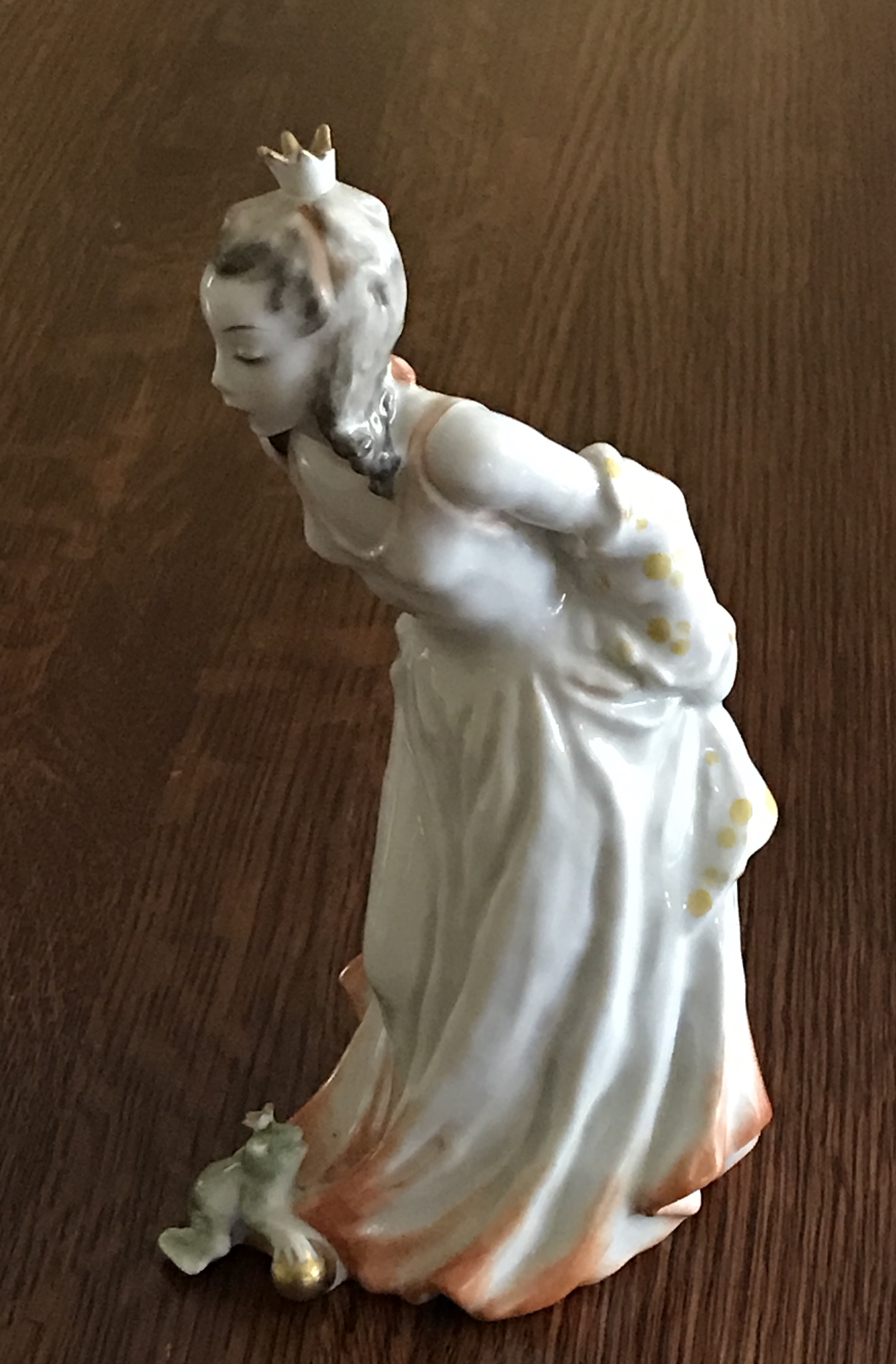
The princess and the frog

In the continuous exploration to understand my emotional story, there are two incidents both decades apart, that have stood out in my memory. Now in my late sixties, I allow myself to experience old, stifled feelings, and realize that both incidents have remained vividly in my brain namely because they are symbolic, and represent quite clearly for me the essence of my relationship with my mother. The first I wrote about in Don’t Get So Upset: Help Young Children Manage Their Feelings by Understanding Your Own (Jacobson, 2008). As I look back and reflect upon that incident, I think that was the night I officially lost my emotional birthright. The way I understand it, from that night on, I was no longer a priority for my mother.

The second incident happened over a decade ago when, as a grown woman, I traveled to Israel as I did each year to visit my mother, who was then in her late eighties. At that time, she was living in a small cottage on her estate having rented out her larger house. By then I already knew that she planned to leave her entire estate with all its contents to my younger brother, for she had notified us all of her decision over twenty years prior, a few years before I immigrated to the United States. During the summer of my visit, mother's little house was unbearably hot, and she had to haul her laundry up to the top of her property to my brother’s cottage. I went out and surprised her by purchasing a small washing machine, air conditioning unit, and a CD player so that she could listen to the classical music that she loved. One day, shortly after I had given her those gifts, my mother came into the living room and said.” Tamar, choose an ornament to take back to America with you, because as you know everything is going to your brother when I die.” I was surprised at her offer, and, although she did not mention it, I assumed it was her way of showing gratitude for the items I had bought for her. I looked around the room until my eyes rested on a porcelain figurine of the princess and the frog. Even though the crown on the little frog seated at the princess’s feet was chipped, I loved the ornament, which had been in our home since I was young. Feeling excited for the chance to receive such a gift from my mother, I told her of my choice. “No,” she responded sharply and instantly, “That’s your brother’s favorite.” As I was familiar with her usual double bind type interactions with me, I regrouped quickly, giggled and said, “You choose something for me then.” I cannot remember exactly what she chose for me, but when I returned to my home in the United States, I threw it away.

For years when I retold that story, I described it as a humorous anecdote, some kind of idiosyncratic event about my mother’s outrageousness. Recently, since my mother’s death, I finally allowed myself to feel how that incident had, in fact, hurt me. After all she had bequeathed her entire estate, including furnishings, art works, and property to my brother – and she had put me in the position of a double bind – choosing any item, which she immediately took back. In addition, I had just given her items necessary for her comfort. And yet, she chose to deny me in that manner.

While writing my book lately, and reflecting on my relationship with my mother, I suddenly understood how mean and selfishly my mother acted toward me. It hurt me deeply and I wept, realizing that this incident had stayed with me for over a decade because it was representative of how she had always treated me: like an outsider with no rights. When I was eight years old and ill with a tapeworm (as I described in my book), that night she beat me and yelled at me thunderously. However, what was significant about that event wasn't the beatings as much as all the while her saying how I was a disturbance and burden to her husband (my step-father) and new baby (my younger brother). I had to forfeit a mother’s love and support in times of physical need for others more important to her. And then again, years later when confronted with my choosing any ornament at her bidding, I forfeited my wishes for someone more important to her.

These were lessons I learned in my early childhood. Not to be a burden on anyone. And definitely not to express, or even experience any feelings that would make my mother more anxious than she already was. For me, it was not only that I did not receive the unconditional loving and attention a small child deserves, it was that I learned to constantly give my mother the loving and attention she needed, by forfeiting my emotional needs. Indeed, I learned I was not deserving of anything.

Fullsizeoutput_101e

After writing this passage a few days ago, I went to my computer and searched for a picture of a small statue depicting the princess and the frog. To my surprise, I discovered, on an Etsy website, an original Rosenthal porcelain figurine from 1939 – an almost exact replica of the one my mother denied me in the double bind choice she offered me so many years ago. It was quite costly, but I instantly purchased it as a gift for the emotionally deprived child within me. 

Yesterday, the princess and the frog arrived in the mail very carefully wrapped up in a large box. I lifted her out and cried and cried. Now she stands before me on my desk as I continue to write my book about "everyone needing attention." 

I figure, it’s just never too late to heal the child within me, or for me to give me the love and attention I lacked growing up.

Two years ago at Mining Nuggets: Memoir again