tamarjacobson

Looking back and thinking forward

Category: Uncategorized

The new world

Quote of the day:

Now it’s a different kind of giving up: the attempt to atone for being born as me. But I am ready. I can feel it in my bones. I no longer believe that I am broken. Geneen Roth
12140060_10205098589045849_7758795104830420630_o

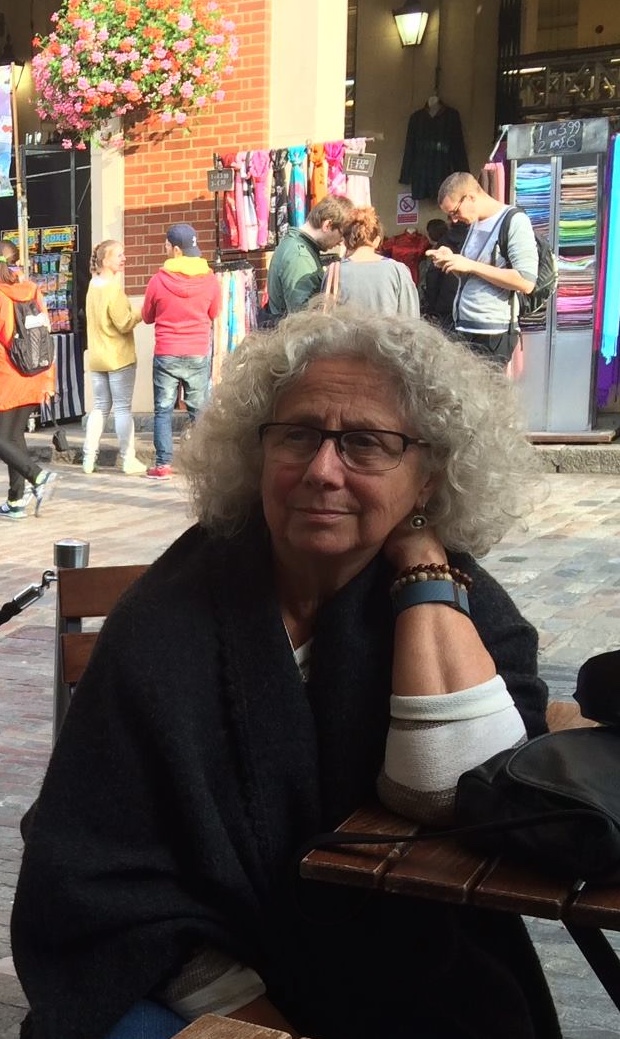
I fell in love with the New World 28 years ago at the beginning of autumn. Of course, at the time, I was not consciously aware that I suffered from a wounded soul. I made my way across oceans and continents in the hopes of opening doors and discovering new opportunities. I was as green as I could be. Indeed, America felt wide open to all manner of possibilities. As much as I studied, worked and journeyed on my way, I was yet to start healing for I was dragging my unwanted and neglected self around with me heavy with ancient notions and ideas about who I was. The past accompanied me everywhere I went with whatever I did, my childhood ever present rising up to greet me in all my endeavors and interactions. It was excruciating at times. I mostly felt culturally illiterate whether it was shopping in a mall or learning how to survive in academia. The simple act of opening doors or turning on faucets would leave me helpless and confused. Everything was so completely different from anything I had done or known before. Education blew open my mind presenting me with options I never knew I had. It was confusing and exhilarating, terrifying and glorious.
Tamarika2

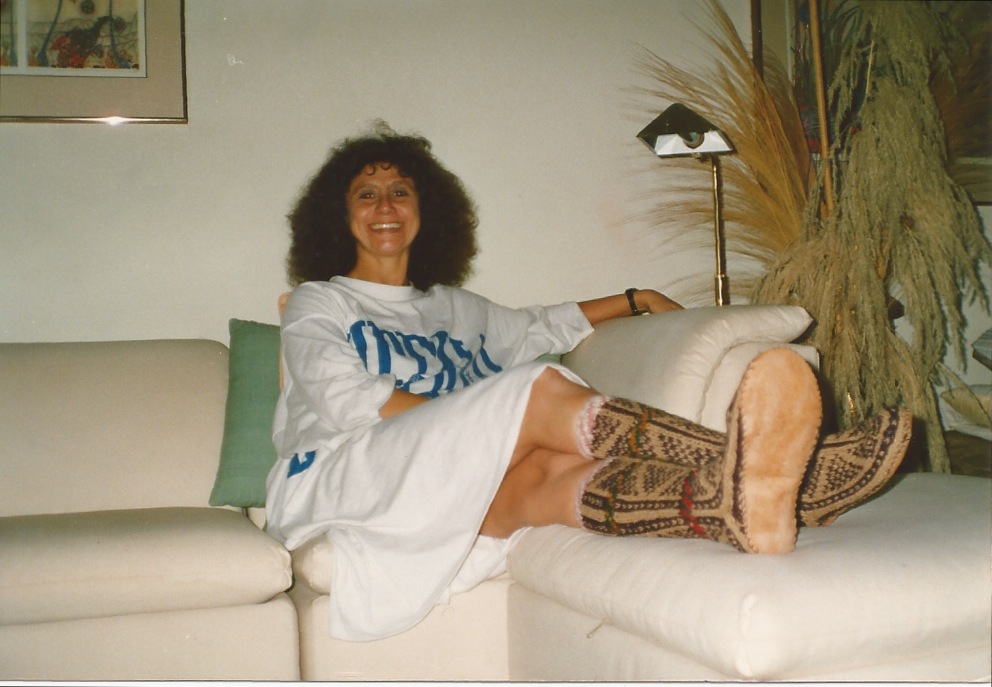
This past week I have been thinking about that time 28 years ago. For it is the anniversary of my first trip to America, the year before my son and I immigrated permanently. I spent a month in Western New York and New York City trying it on for size. When I returned to Israel, my young teenage son asked me how it was. "Like a perpetual sit-com," I responded. "Like the movies, without the background music." Kmart seemed like paradise for one as poor as I was at the time. I bought a red corduroy coat as soon as I entered the front door. It hung on the rack at $15 or so, and I exclaimed, "What a deal!" Looking back I understand it was not an easy ride working and studying long hard hours to realize a dream. Some along the way supported and cheered me on, and there were a few, who tried to hold me back. But I pressed on regardless somehow sensing all the while that redemption was at hand.

Lately, I have been looking ahead as I contemplate future retirement. Sitting quietly in my study this morning surrounded by books, potted plants, blooming violets, cats contentedly sleeping, a steaming cup of coffee, pictures, hand made rugs, and the recurring, chilly breeze of the autumn I fell in love with so many years ago, I experience unfamiliar sensations. It might be fulfillment, or pride, perhaps, in what I managed to achieve thus far. I feel almost healed – not so unwanted and no longer neglected. 

A year ago at Mining Nuggets: Integration

Transitions and necessary losses

'Tis the season. As the Jewish New Year approaches transitions and winds of change are in the air. Days are slightly shortened with a cooler evening breeze, and it is time for self-reflection again. I think about how many times in my life I have weathered all manner of transitions – the list seems endless: changing countries, continents, cities, states; leaving relationships, and entering new ones; shifting professional positions in various workplaces; moving apartments, homes, or offices; traveling or staying close; packing boxes and making sandwiches; hanging up pictures, throwing out old memorabilia, and collecting new memories; repotting plants that have outgrown their space, and throwing out old ones that have given up their ghost; switching titles, name plates, or rewriting business cards. 

One would think that I would be used to it by now. However, with each change, reinvention or move, even as I joyously hail in a different era, I experience butterflies in my stomach, and feel a sense of loss. For with each transition, as positive as it is, there is a release of old ways and expectations, and a shift in relationship dynamics until settling down into new routines take place. 

Necessary losses are when we shed the cocoon that nurtured our survival, as we fly up and out into unknown adventures on gossamer wings. They are times when we give up old psychological paradigms for new perspectives. Lonely, exciting, and painful … perhaps … but nevertheless necessary for emotional growth. 

For me, arriving at a new place is hardly instantaneous or coincidence. I have been shedding ancient psychological paradigms these past few years. It has been hard, emotional work, but recently I felt it paying off as I hung up old pictures and posters in my new office, looked out at a different view through old windows, and lined up books on the shelves. I sensed all around me something quiet, peaceful, solid, and authentic. As if I arrived intentionally, and that was exactly where I wanted to be – right there – right at that moment.

A year ago at Mining Nuggets: As in being seized by the moment

The shift

As I entered into meditation this morning in the early dawn before sun rise, a feeling came over me as I bent my legs into siddhasana, and straightened my back. I remembered Wendy leading us in meditation early in the mornings at Villa Lina. She would tell us to imagine a thin string pulling the back of our heads up toward the sky. This morning, as I imagined that tiny piece of string pulling the back of my head toward the sky once more, I felt my back stretch and straighten, and I breathed in and out deeply. A peaceful feeling came over me, and I experienced a shift happening inside my brain. It felt different. A new sensation that I could not understand completely. Almost like a shift in gears. Just not as sharp or definite. Amorphous like a gentle vibration. As the mantra floated away I thought to myself, "Is there a change in chemistry happening in my brain since my perceptions and attitudes are changing?" It was a fleeting thought – a mili-mili second of a reflection until I coaxed the mantra back. But it stayed with me nevertheless, and when I came to the end of the meditation and breathing exercises, I opened my eyes and the sun was shining right at me through the window.

Memoir again

Gaillardia-Blanket-Flower

In a way I have been writing pieces of a memoir for years on this blog. Indeed, I have been recording my life and sharing it publicly, and at many different points I thought that I had a story to tell, one that would resonate with other readers. Recently I have been thinking about why I have not yet taken on the challenge of putting all the pieces together and fashioning out an organized publication. Most memoirs that I read and enjoy, tell a story of memories and resilience in the face of adversity, which come in various forms including difficult or abusive childhoods, catastrophes or life tragedies. I have no doubt that many people who write memoirs also work through issues in their life, dealing with grief, or trying to understand how their lives panned out. 

In therapy, and in this blog, I work through my issues, deal with grief, and understand how and why I made the life choices I made. At times I even marvel at my resilience in the face of various adversities, and how I become more aware of why I have done the things I did, or how my relationships developed. Indeed, I have uncovered most of the family myths and secrets during all the years of self-work, and have allowed myself to confront some of the most painful situations. I am even able to understand how the past affects my personal or professional relationships in the present. There is no doubt in my mind that this type of self scrutiny has helped me become more confident, self actualized, and empowered.

Today I no longer have a need to create a formal memoir. My story is not more unique than so many others out there. I feel fortunate and grateful that I have been able to survive and, indeed, thrive personally and professionally. These realizations have given me a new kind of patience, acceptance, and inner peace for my life going forward, and I am developing courage that will help me formulate different stories as I enter older age. 

Here, for example, is a short one: In June I was visiting my 98-year-old mother in Israel. The two weeks were filled with all kinds of complex feelings: sorrow at seeing her large and vibrant life fading away, amazement at her lucidity and wisdom, pain at remembering some of the ways I wished she had noticed me when I was young. During the last week of my visit, my mother wanted me to know the name of one of the flowers she especially likes. My mother was always an avid gardener. I learned to love gardening directly from her through her enthusiasm as she shared wonder and delight about this or that flower, creeper or different colored leaves of plants in her yard. Now that she is bed-ridden and unable to physically tend the earth, her carer gardens for her according to her instructions and ideas. Outside the window of her bedroom is a piece of land full of exotic plants and flowers – some in pots and others directly in the ground. As I walked through the garden, I was filled with wonder and love at her energy and enthusiasm even at this grand old age of 98 years. During that last week together, she wistfully mentioned the one type of flower in her garden, and longed to remember its name.

Yesterday I visited a dear friend in Princeton. It had been a painful couple of weeks for me as I transitioned to a new position at work, and after I had finished setting up my new office, my friend offered me comfort and support in her home sharing a fine lunch of quiche and salad, including a desert of tiny mini-eclairs filled with luscious cream. When we had done eating and talking, we looked through her large windows into her garden. She pointed out some new flowers she had planted recently – daisy-like in bright oranges and browns – and she named them: Gaillardias. Instantly I remembered the flower my mother had described to me in June, and marveled at how she had longed to remember its name. I said to my friend, "I will buy some this week and plant them in my garden in my mother's name."

As I write this, I smile and think of how grateful I am to my mother for modeling such a love of plants, and especially for how much comfort I received yesterday from discovering the name of one of her favorite flowers.

A year ago at Mining Nuggets: Don't let go … live it through!

Gratitude

IMG_2856

Quote of the day:

When a person doesn't have gratitude, something is missing in his or her humanity. Eli Weisel

I sink my teeth into a meat-loaf sandwich neatly cut diagonally in half, and slightly flavored with a smidge of ketchup. It is one of three food items perfectly prepared, separated, and packaged each in a small plastic bag: a hard boiled egg, two walnut fudge brownies, and the meat loaf sandwich. I sit in the airport lounge early in the morning; my eyes still drooping with unfinished sleep, while hundreds of people bustle to and fro around me coming and going between food stalls and airline flight gates. I feel warm and cared for. Like a child, whose mother stayed up late the night before, placing in a brown bag all the food she had carefully prepared for me while I slept. She was thinking of my tiring journey ahead and wanted me to sense through her tender gifts of special food that home was never far away, even as I chose to stray far afield. I sit on the hard chair by the table outside the security check point, where I had come through rushing chaotically with hundreds of others, frenziedly pulling off shoes, jackets, and dragging out laptops and plastic bags of toiletries to place in large, plastic, grey trays on conveyor belts. Walking through the screening gate, machines beep and whistle as security agents pull me aside to full-body check me only to discover I had forgotten to remove my necklace in the mad dash through. Exhausted and drowsy from rising at the edge of dawn to make it in time to the airport, I munch on the sandwich staring vacantly ahead at nothing in particular, and as I start to relax an overwhelming feeling of gratitude envelops me to the point of tears. I realize that I cannot remember when anyone in my own family had so lovingly made me such a food parcel to take on my way anywhere. Indeed, I fended for myself – alone – from as far back as I can remember. I silently give thanks to my mother-in-law for the care she has shown me with my goodie bag – not only for today in the Seattle airport on my way home to Philadelphia – but for all the tins of Christmas cookies she sends me year after year in December just because she knows I like them so much. Gratitude in that moment gives me renewed energy and exhaustion drifts away. In its place I discover a stronger sense of self-worth, and now when I stare ahead I notice women and men, young and old, families with children, a man walking his dog, and a couple hand in hand. I feel a part of the human family around me, knowing that home in Seattle is never far away even as I set out for my own in Philadelphia.

Gratitude is key to a sense of self-worth and belonging, I realize. There is joy and hope in feeling grateful for who we are, what we have, and how we give and receive. It washes away bitterness and ancient wounds, and helps me open myself up to love.

A year ago at Mining Nuggets: Countdown to 65

Mother’s Day 2015

Driving down the road the other day, reflecting on this or that personal situation happening in my life, I suddenly experienced a rush of emotion that tapped into an old feeling from childhood. It brought tears to overflowing, and surprised me so much that I exclaimed out loud alone in the car: "Please don't hurt me. I want you to love me." I realized then and there how much I had longed for my mother to love me even when she disapproved of my behavior, or if my self expression was not what she wanted to hear. Perhaps I needed her support especially because I was struggling to find my own identity even if it meant pushing against her will. 

Mother's Day is upon us, and it has me thinking about mothering in the broadest sense, especially since the other day at a coffee shop where I had gone to write, I witnessed a young mother being harsh with her young child.

One of the core challenges in parenting or teaching young children is creating boundaries for them without repressing their authentic emotional selves. Please don't hurt them – they want us to love them. That's the dance – the constant negotiation.

We want our children to be safe and successful, and act like we know the way to get there. We have learned from our parents and our own mistakes. We have learned what to fear and what not to care about in order to survive and become successful ourselves. We have developed a perspective and world view about how children should behave and what constitutes success in general. We pour our fears, biases and survival skills all over our smallest children, and try to formulate little people in our own image. We do all of this with good intentions and love … whatever that is. Because what do we know about love other than the way we have been loved?

Are we loving in the same way we were loved, or are we trying not to do what was done to us? Whatever all that amounts to – do we really know who our children are? Or what they aspire to? Or what they fear or long for? So much of what they do is either to please or push against us depending on their developmental age and fears. At the core of a young child must be a feeling that they cannot express: "Please don't hurt me. I want you to love me." For young children need our love to survive, but they also want us to love them for who they are – for their unique constellation of characteristics and personality – for the complex configuration of genes from generations ago and from right now.

Can we love them fat or thin, shiny or sad, angry and grumpy, joyous and loudly enthusiastic? Can we rejoice in their independent thinking, sexuality and smarts, support their confusion and insecurities, and not take it personally? As they find out who they are, what they need or desire, and how to express themselves emotionally, can we be there for them with full attention, love and support for that exploration? 

The process is complex to be sure, for how much do we really know ourselves? Are we aware of how our own early childhood affected our world view, or are those memories already repressed somewhere deep in our psyche? What do we do to get in touch with those feelings, and if we recognize them, how much do we allow ourselves to face them?

How do we allow our children to follow their heart all the while loving them for it, even when they are so different from who we are?

Please don’t hurt me: I want you to love me

Driving down the road the other day, reflecting on this or that personal situation happening in my life, I suddenly experienced a rush of emotion that tapped into an old feeling from childhood. It brought tears to overflowing, and surprised me so much that I exclaimed out loud alone in the car: "Please don't hurt me. I want you to love me." I realized then and there how much I had longed for my mother to love me even when she disapproved of my behavior, or if my self expression was not what she wanted to hear. Perhaps I needed her support especially because I was struggling to find my own identity even if it meant pushing against her will. 

Mother's Day is upon us, and it has me thinking about mothering in the broadest sense, especially since the other day at a coffee shop where I had gone to write, I witnessed a young mother being harsh with her young child.

One of the core challenges in parenting or teaching young children is creating boundaries for them without repressing their authentic emotional selves. Please don't hurt them – they want us to love them. That's the dance – the constant negotiation.

We want our children to be safe and successful, and act like we know the way to get there. We have learned from our parents and our own mistakes. We have learned what to fear and what not to care about in order to survive and become successful ourselves. We have developed a perspective and world view about how children should behave and what constitutes success in general. We pour our fears, biases and survival skills all over our smallest children, and try to formulate little people in our own image. We do all of this with good intentions and love … whatever that is. Because what do we know about love other than the way we have been loved?

Are we loving in the same way we were loved, or are we trying not to do what was done to us? Whatever all that amounts to – do we really know who our children are? Or what they aspire to? Or what they fear or long for? So much of what they do is either to please or push against us depending on their developmental age and fears. At the core of a young child must be a feeling that they cannot express: "Please don't hurt me. I want you to love me." For young children need our love to survive, but they also want us to love them for who they are – for their unique constellation of characteristics and personality – for the complex configuration of genes from generations ago and from right now.

Can we love them fat or thin, shiny or sad, angry and grumpy, joyous and loudly enthusiastic? Can we rejoice in their independent thinking, sexuality and smarts, support their confusion and insecurities, and not take it personally? As they find out who they are, what they need or desire, and how to express themselves emotionally, can we be there for them with full attention, love and support for that exploration? 

The process is complex to be sure, for how much do we really know ourselves? Are we aware of how our own early childhood affected our world view, or are those memories already repressed somewhere deep in our psyche? What do we do to get in touch with those feelings, and if we recognize them, how much do we allow ourselves to face them?

How do we allow our children to follow their heart all the while loving them for it, even when they are so different from who we are?

Releasing the shackles

I had the weirdest sensation on Sunday morning as I prepared to walk in the Wissahickon Valley. I hooked up my earphones and opened the Map-My-Walk app to record how many miles I would go. As I set out, music started playing from the playlist I created for my four to six mile walks, each song or melody reaching into my brain much like a meditation as I strode out into the spring day. It was the perfect spring day with cool temperatures and an almost clear blue sky above the tall, old trees lining the Wissahickon creek. Leaves turning the softest shades of green and some trees or shrubs bursting out in pale, pink or white blossoms. Along the way people were arriving onto the path as if tumbling out of their wintry stupors to soak in the fresh, hopeful air of rebirth everywhere around us. Some accompanied by dogs of all shapes and sizes, others jogging, cycling, riding astride the odd horse or two, or walking steadily along Forbidden Drive like me. 

Out of the blue, I felt something strange happening around my wrists and ankles – something I had never felt before. It was as if iron shackles were snapping apart and releasing me. So vividly real was the feeling, that I could hear the irons clanking open, and I almost stumbled with the force as they broke apart. I stood still briefly experiencing the sensation, and tears of joy and relief filled my eyes. A rush of freedom washed over me, and I started to walk again. This time, my step was light and I seemed to flow forward along the path with a force of energy the likes of which I have not experienced before. I might have thought I had dreamt it all except that the feeling of freedom and relief stayed with me for the full two hours of my walk, and even through the brunch I treated myself to in the little coffee shop at the end of the trail – a full three miles before returning on the second half of the walk for the next three miles. Indeed, even two days later, the full force of that feeling has remained with me.

I am still not quite sure what it portends, and there will be time to process it further going forward, but one thing is sure, I am letting go of something big within me. After all, I have been a prisoner of my mind and ancient paradigms for long enough, and the old rules that helped me survive as a child clearly no longer apply to me. 

One month later

Have I been so busy that a month has passed me by without writing on this blog? I know there were travels across the country and many presentations, that's true. But what about all the thoughts and feelings wandering through my brain while these things were happening? I know I thought of many blog posts even as my days were full of this and that.

Ah, and there's always the book that I am writing. That takes up much of my time, for it fills my thoughts throughout the days, accompanying me on trips to the grocery store, on my walks, and at times even when I am chatting with neighbors. I had forgotten what it is like to be all consumed with my literary endeavors, and I am so privileged this semester to have the time to do just that: allow myself to be consumed. 

Apart from all of that though, this past month I have found peace of mind about my early childhood and the connections with the present reality. It started in March in Oxford, although it had been a long time coming through all the psychological work that I have been doing on myself over the years. I felt it in my presentations this past month, and as I stride out on my daily four-mile walk. I sense it as I take care of myself more and more – whether it is in preparing a variety of salads for dinner just for me alone while Life Partner is away on his travels; or sleeping in until six in the morning – one hour later than usual! Something has shifted within me.

It has taken a long time getting here, and continues to be a process of uncovering the inner workings of my emotional memory. I understand the reasons why. Some might call it forgiveness. Forgiveness for the people who hurt me so deeply – who broke my heart over and over again – forgiveness for myself for some of the choices I made. I call it understanding with my emotional brain – not the rational one. Understanding in my guts, if you will. Understanding that people who broke my heart knew not what they did. They had unresolved emotional issues, which they took out on me because I was so willing to believe their truths – so desperate was I for their love and acknowledgement. Understanding that the choices I made were the best I could do with the undeveloped awareness I had at the time. 

This type of understanding helps me heal my broken heart. It allows me to forgive myself for who I am and what I feel. 

Opened to closure

10646879_10101997369881633_8336437288616416665_n

This past week, being in Oxford in my own right as an academic and intellectual, I experienced what can only be described as a feeling of closure. Indeed, it was the first time in my life that I did not yearn for acknowledgment from my mother or older brother for my accomplishments. I felt completely comfortable in my own skin: included in a community of my peers, and up to the intellectual task set before me. I wandered the streets of the ancient collegiate city, probably down the very streets that my brother had walked decades ago when he had the good fortune and privilege to study there. And, for the first time in my life, I felt akin to him, and equal in academic stature. At times I even allowed myself to feel pride in the hard work I had done these past twenty years to place me where I am today. It was a very good and solid feeling. Not arrogant or prideful – but peaceful and happy. On Friday, last week as I sat with Life Partner at a quaint but classy little pub in Hampstead, London, it suddenly occurred to me that in order to experience closure, I had to first be opened up. 

It has taken years for me to face my deepest feelings about so much that went on for me as a young child. While I might have known about my situation cognitively, I would have to allow myself to feel what I felt as a child before I could truly understand what I had been through. I would have to digest the hurt, experience the pain, and confront my fears head and heart on, in order to let go and move on. It took me until my late fifties to allow myself to do this. As I write this I realize that I waited that long because I must have feared the pain. And yet, when I confronted it together with my therapist these past few years, it was not at all as excruciating as I had anticipated. Oh, there were times that I wept and raged, but when I held still and allowed myself to feel the sensations from decades prior, it became more and more manageable, always followed by a feeling of relief that was worth everything I had gone through. 

My older brother died about a year and a half ago, and what with one thing and another, I was unable to attend his funeral. And so, with my trip to Oxford, I initially planned a type of pilgrimage to his grave in another town to pay my respects. I had hoped that I might experience a feeling of closure with such a visit, because of the many complex feelings that I had within the context of my past relationship with him.

However, as I walked the streets of his alma mater, it was enough for me to feel a deep sense of peace in taking my leave of him.