tamarjacobson

Looking back and thinking forward

Category: Uncategorized

Reflections on self-regulation

Quote of the day:

For children, intense emotions are like a dark forest at night. Trees rustle in the wind, bats circle above, and all manner of insects crawl along the ground, but in the darkness they are impossible to see, let alone understand. The brain starts making associations, and the child becomes overwhelmed with dark imaginings. When we use discipline methods like time-out, we essentially usher our kids into the woods and just leave them there in the darkness. More, we actually tell them to sit silently and not move no matter what they experience so that they can “reflect” on their actions (Thompson).

It is the very idea of self-regulation or self-soothing, that is at the source of our aversion to children needing our attention. In other words, “Kids, get on with it! … do not disrupt our routine. We have much more important issues to deal with right now: Reading, math, assessments, administrators stopping by to see how well I run my classroom. It must not seem messy or chaotic. I must look like I have control of my classroom. So – self-regulate – self-soothe, and please, whatever you do, do not need me! I have much more important things to deal with here.” And yet, in any society that includes different and unique human beings, relationships are going to be fraught with challenges, chaos, and yes, a lot of messiness.

In a democratic or what some might like to term a “civilized society,” we long for a sense of order and responsibility, where everyone knows their place and space, and people consider others responsibly. If we are self-regulated and abide by the rules of conduct, there will be no mess, infraction, disruption, or intrusion into personal space. What we forget is that societies of all descriptions are made up of human beings with different feelings and needs.

So, where do I begin to think about self-regulation? This is the latest buzz word for young children to learn some kind of self-control when it comes to classroom management. The intent behind the expression is admirable. In order to succeed academically and emotionally, young children need to learn how to live in society by understanding its norms and rules. We also want them to become contributing members of our society – our adult world. Somehow, however, it becomes punitive as teachers and parents take on a behaviorist approach using punishments and rewards to teach children how to learn to self-regulate. Instead, self-regulation becomes about pleasing people, and stifling emotions: “I will do anything, just please don’t ignore me.” What about empathy and compassion, or making a stand for social justice? How do we learn these characteristics by pleasing people?

For example, let’s say a child doesn’t get what we are telling her the first time. Perhaps she needs it repeated a few times. I know I am like that when something makes me anxious or insecure. I might need the other person to repeat for me so that I feel safe in that context. Saying to me, “How many times must I tell you that?” will only make me feel like I am burdening the other person – that there must be something wrong with me because I need it repeated. I would rather remain silent and please the teacher, than ask her to repeat it one more time, and appear a nag, a whiner, or, worse still, a burden on her time.

So – as adults, teachers and parents, how do we determine when a child is emotionally capable of understanding the adult objectives of self-regulation? For example, I think of the five-year-old who had been moved from foster home to foster home – feeling he was to blame for each abandonment – arriving in a school classroom and finding it so very difficult to self-regulate – an emotional bundle of self-worthlessness. In the end, of course, not only was he expelled from the school, out of the teacher's frustration that he would not conform to their strict rules, he was moved to yet another foster home. At which time in his life would a compassionate adult hold still long enough to give him enough attention that he craved for to break the cycle of abandonment? How does a young child express to us their fear of abandonment? Their longing for more of us? How do we gauge what is the right amount for each person? When will we understand that children will do anything to please us or get us to like them – for they need our affirmation for their emotional survival – and when that fails they will show us in all sorts of ways usually as evident as we care to admit – how deeply they hurt.

In all the books and articles that I have been reading lately with advice about classroom management, or discipline strategies, the term disruption is bandied about freely. Especially as something wrong, that has to be averted at all costs. The concept of “disruption,” is as fraught with negative connotation as could be. For, of course we do not want people “disrupting” our lives. But allow me to delve deeper into understanding what we mean by “disruption.” It means we have some sort of plan or world order that must take place without diversion. If we are led down a different path, what might happen? Danger? Loss of control? Often when I am giving a presentation about a certain topic, I find myself diverting to different ideas and associations along the way. I have an outline, a plan, and even a Power Point presentation to guide me. However, as I speak and others comment, interrupt, or share their ideas and emotions, I find I must go in different directions to accommodate and include them. I do not see them as a disruption to my plan. On the contrary, they enhance it, give it depth, and I learn new things about human emotion, the lives of others, and the human condition overall. I develop more and more compassion and acceptance of the diversity of humanity. It is enormously beneficial in the long run.

It is the same for teaching young children in a classroom. Of course, we have a plan, an agenda. But along the way, ideas and feelings of the children in this mini-society of human beings – the classroom – must disrupt our attention to something larger, more complex, and essential to a bigger picture of how people live together in community. We learn together, not only how to read or write, but how we communicate with one another, how we care about each other, and how we can all contribute to the whole community we are living in by stopping to listen to one another with empathy and compassion. At the end, we return to our original plan with newer, fresher ideas, feeling strengthened by our collective humanity. The word disruption should be banned from our understanding about discipline and learning how to live with one another in a compassionate and productive society. It is not a disruption. Rather it is an opportunity to widen our emotional understanding of one another – to learn something new about one another. We should seize the opportunity with excitement, even joy.

A year ago at Mining Nuggets: Feeling the feelings
Making a difference

Quote of the day:

"That's often where courage begins: With the story we tell ourselves about who we are and what's important, and about our capacity to make a difference …" Barack Obama receiving the Profile in Courage Award, JFK Library Foundation, May 7, 2017

Riffing off the quote above as I choose to use it for personal reflection:

Who I am and what's important, and about my capacity to make a difference … I am five foot one inch tall, rather too plump at this older age in my life and wanting to trim it down a bit for my health. I have a doctorate in education with an emphasis in the early childhood years, and so have become an early childhood teacher educator in a small, private, struggling university. But am on my way out with a phased retirement plan and I have a Senior card so that I only need to pay $1 when I take the local train downtown Philadelphia. I have written books that focus on teachers' self-reflection about their emotional development, and helps them make connections between what they learned as young children, and how they interact and behave with children and families. I am in the process of writing another book about children's need for attention. I travel around the country and facilitate professional development workshops and make speeches for early childhood professionals about the topics of my books. I think I have some capacity to make a difference in the lives of very young children when I am able to reach their teachers – or parents – and help them understand the importance of relationship and attachment as the foundation for healthy emotional development and young children's emotional well-being. 

Making a difference takes time, and I am not always sure if I, in fact, do make a difference. After all, change is incremental and oftentimes regressive. We have been given our emotional scripts in our early childhood, and changing that script is difficult to do when it is so deeply embedded in the emotional memory of our brain. Sometimes I feel satisfaction if I manage to reach ten percent of the participants, who attend my workshops or presentations. And even then, I am not sure about the impact I might have. The older I become, the more I realize that change is a "drip-drip" process. It happens very slowly. That doesn't mean I should give up, and I seldom feel despondent. Because every now and then I see that someone has taken to heart and significantly understands what I am on about, and I notice a change in behavior that is authentic and substantial. 

So, I wonder to myself: What is my contribution? I think it is persistence in the face of obstacles – personal and professional – and a conviction that what I am offering for children is the right thing to do because it is about compassion and authenticity. In addition, I believe that in telling my story, and sharing the process of my own psychological development and understanding, I am giving others the opportunity to courageously confront their own. For when we face ourselves, we are able to make choices about how to go about making the changes necessary for our own emotional health and well-being. This must come first, or in accompaniment with our work with children and families, as we facilitate their growth, and offer them options for change in the way they perceive themselves and their lives. I want to contribute to how they will make choices for their own emotional health and well-being – and, especially, in how they will interact with others, and in the types of relationships they will develop going forward.

Two years ago at Mining Nuggets: Gratitude

Peering behind the door

In Old Friend From Far AwayNatalie Goldberg writes:

Let's look another time at this worry about what people close to you – or people not close to you – will criticize you for. What are you going to do? Walk around with masking tape glued over your mouth? You have to speak. That's why you put the pen in your hand to begin with: in order not to blank out or turn your back. You have to be willing to go into the hot, steamy center, to go to the mat for sorrow, grief, concern, in order to shed light on what has been in shadow … (Page 33)

In Bird By BirdAnne Lamott writes:

We write to expose the unexposed. If there is one door in the castle you have been told not to go through, you must … You can't do this without discovering your own true voice, and you can't find your own true voice and peer behind the door and report honestly and clearly to us if your parents are reading over your shoulder. They are probably the ones who told you not to open that door in the first place. You can tell if they're there because a small voice will say, "Oh, whoops, don't say that, that's a secret" … So you have to breathe or pray or do therapy to send them away … (Page 198 & 199)

Yes, I respond.

I have put the pen in my hand to begin with (since age sixteen, actually) in order not to blank out or turn my back.

And, yes.

I must go through the door in the castle even when I was told not to. For, I must discover my own true voice.

This is something that has been driving me for a very long time. Searching for my voice about my experience growing up; my voice about quality relationships for children's emotional health and well-being as a priority – even more important than reading and writing; and most importantly, my voice about teachers and parents reflecting on their own childhood, and making connections between that and how they understand, and thus, interact with young children and others. 

And yet …

It is the very fear of what others think of me, or how they are metaphorically reading over my shoulder, that stops me in my tracks each time just as I am about to put pen in hand, or peer around the forbidden door. Some might call it writer's block. I call it my dilemma about loyalty. For, my loyalty has too often been called into question - sometimes just through silence or shunning of me by others, and at other times through their harsh, shaming, painful words to me. The very fact of my questioning, or trying to understand the dynamics of relationships that affected my emotional development has been termed disloyal. My own experience of my life has been called a lie. So much so that I have learned not to trust my own emotions. 

And so …

Recently, I discover in therapy that I am standing at a cross roads. Just as I am now at a stage in my life of confidence and freedom to be myself, at the same time the past questioning about my validity and loyalty rises up to block me from writing down what I know to be my truth – about my Self, and especially as it pertains to the subject of children needing attention – relationship – from those significant adults in their lives. It seems that I cannot shrug off, let go, or rid myself of the role I was taught way back as a young child – to be good, quiet and unquestioning so as to receive any love or acceptance at all. And if I did question or speak out – rejection and shaming was inevitable. 

At my last therapy session I was given a choice – a challenge: Slip back and paralyze myself remaining stuck within my old childhood mythology, or flourish as an older woman, who knows both from experience and knowledge what is best emotionally for me and young children, and who feels free to share her own powerful story to benefit others.

A year ago at Mining Nuggets: In honor of …

Holding out for a sign

Somewhere there inside all my stifled emotions was the feeling that my mother would, at the end, acknowledge or validate me in some way. I did not expect an apology for the way I had been excluded and shunned time and again since I was a young child although I think I might have held out for one. I did not expect to be acknowledged, or validated, although I think I might have been holding out for that. These feelings were so submerged – stifled away into the depths of my psyche so as to surprise me when I finally allowed myself to feel them. For the pain of it all rose up suddenly in the most unexpected places and moments as I began the real grieving process for her death over a month ago.

When I returned from Israel after her funeral and the shiva, I was numb. Shocked. My mother had defied death for five years, and in any case I could not imagine a world without her. She had been such an enormous presence and influence in my life, and I had yearned for her love and acknowledgement forever. As the days drifted by, emotions started to push and poke through my numbed state. I began to realize that during the last weeks that I sat with her, played her music I thought she might enjoy, and stroked her hair and hands, telling her I loved her, I was holding out for a sign. Some sort of recognition of my devotion and love – a smile, perhaps, a holding onto my hand. Something. Anything. It never came, even though I heard from others that she had turned toward them and smiled in a way that seemed intentional. Even as we laid her body to rest in the small village cemetery, I realized that like a child, I was waiting for her to rise up out of the grave and exclaim: "Hey! Tamar – I loved you – don't forget that!"

And then again, when the will was read, and I realized once and for all that there was no mention of me or my son – not even in the smallest way – emotions started to push through my crumbling, numbed state. Feelings of sadness and anger at to the end not having been acknowledged in any way. 

While it has been excruciating at times, I have been making connections with my complicated feelings and the book I am writing about children needing our attention. For even at age 67 I realize how important it is to be recognized by significant adults in our lives. These feelings from childhood never really leave us. They return over and over again in different forms and at unexpected moments. It accentuates for me just how important it is to give our youngest children the feeling that they are wanted, loved, noticed, and worthwhile – just by the fact of who they are and what they have to contribute. For there is nothing as painful as having our love rejected or ignored. Giving or withholding of attention is really all about relationship. It is not an act on its own. It is connected to all the complex feelings we have toward one another. Now that I am an adult, I understand that many of the times I was ignored, criticized or excluded had nothing to do with who I am or even what I had done. It had everything to do with my mother's insecurities, feelings of disappointment and frustration about her own life and relationship with her mother, husbands … etc. I just happened to be there at the moments she needed to lash out or release those complex feelings about herself. However, as a child I couldn't be aware of all of that, and still I needed her to be there for me emotionally. 

Supported by dear friends and working with my therapist, my grief process feels manageable. More and more I am able to understand that having all these complex feelings is not bad, strange, or even that something is wrong with me. I understand more about my mother, and who she was as a person – charismatic, strong-willed, and who went through a lot in her own life of one hundred years. I realize some of the great things I learned from her: love of gardening, reading, and music. I am able to balance all that with sadness at losing her, all hope of her ever acknowledging me, and the pain of what I yearned for from her as a child, and even as her adult daughter.

Perhaps, at this grand old age of 67, soon to be 68, I can be proud of what I have accomplished in spite of all that stuff, continue to mother myself, learn more about my own self worth, and, finally, change my emotional life script for good! 

A year ago at Mining Nuggets: Self-regulation

Openings

The past three weeks I have been opening windows into my past life when I lived in Israel for twenty years, almost thirty years ago. I have discovered that I was hard working and a devoted mother, and that some people liked me back then. I also peeked into windows that helped me see just how much I lacked confidence back then. For so long I believed that there was something wrong with, me or that I was a bad person. But as I looked at my past home, and thought about relationships with others at the time, I see only that I lacked self-worth in the deepest way. 

It has been difficult for me to confront this reality because of course it makes me realize that some of the choices I made were so obviously based on not feeling deserving of being treated well, or even kindly, by others. All of this I have been reflecting upon these past five years in therapy. But somehow, this visit to Israel this time has confirmed my understanding at a much more profound level.

I get it! 

At moments when it has been painful, I am strengthened by the knowledge that all those feelings are about the past, and that my present reality is different now. I am not a child or young woman searching for love or acknowledgement any longer. I am all the ages of me I ever will be (as Fred Rogers said), and I am beginning to accept, and even quite like, what I understand about who I am today. 

Closure

I have been thinking about closure quite a lot lately. Tying up loose ends of my past as I plan a trip home to Israel from where I immigrated to the United States almost thirty years ago. I have been invited to close out some old retirement accounts that popped up out of nowhere suddenly, bringing with them memories of the nineteen years I spent in Israel as a preschool teacher with the Ministry of Education. I had thought that all that went before I came to the States had been closed. But there it was – opened up again – like a wound that has been lying dormant closed over with a thick, impenetrable scar. Memories have been flooding in like a tsunami. I wake up in the middle of the night with them. They haunt me in the shower and on my walks. Sometimes they appear while I am chatting with a neighbor on a street corner. There I was, thinking I had successfully closed them out with my new American life. As they say in Magnolia, "The book says, "We might be through with the past, but the past ain't through with us.""

So, what do I mean when I say I want closure? I dream of closure so that I can move on. But what does that mean? Can I really just put the past behind and never look back? I have tried that. And, I always feel like there must be something wrong with me because the past is never fully done with me. As my therapist said the other day: we can never escape our childhoods. Our earliest childhood experiences remain impressed in the emotional memory of our brains. They fashion how we perceive the world, and how we developed our defense mechanisms in order to survive confusion and frustrations with significant adults when we were very young. We repeat our emotional life scripts over and over again. Part of therapy is becoming acquainted with those life scripts and survival skills and learning how to re, or un-learn them. I don't need to escape or close them down. Just become acquainted – and then I am able to choose different options. 

I know a number of people, who tell me they have put everything behind them, and have moved on. And yet I see them repeating old patterns of behaviors and interactions over and over again. I might close the lid on traumatic experiences or old wounds but every now and again they peak out of the box with painful reminders. So, what if I just welcome in the old wounds, greet and acknowledge their existence? What if I explore and examine, breathe in and out of them, and make them part of who I am right now? I think I dream of closure out of fear of the pain. But, more and more I discover that pain is just that – pain. And the more I befriend it, the less it hurts. I long to lay down my burdens, and walk on feeling lighter, but I find that I carry them within anyway, and the lightness of feeling is only temporary. 

So, when I go home next week I plan to explore the old haunts, physically and emotionally, greet them and get to know them from the vantage point of being older and wiser. Perhaps I will be able to forgive myself and others for doing what we all could with who we were, and what we knew at the time: Young, imperfect, unable to see further than our egocentric selves were capable of experiencing – pretty much doing the best we could with how we had learned to perceive our own realities, as we peered through our survival, defense mechanisms.  

And … I think I will give up on this notion of closure … and hope to move on lighter anyway.

On-your-side-ness

At the core of my beliefs about working with children is that children need us to make a stand for them emotionally. At so many levels I feel this, but probably because when I was a child no one protected me emotionally – no one made a stand for me. I have since developed what I describe as an on-your-side-ness for children. I give children the benefit of the doubt. I realize that while children need our support and for us to relate to them validating and accepting their feelings – at the same time adults are recovering children who need their own attention and relationships too. We all needed someone to make a stand for us emotionally when we were growing up. If we did not receive it how can we learn to think about this or feel the same way toward others? This question is central to my work with children and teachers. How do we balance it so that everyone gets their emotional needs met especially when children are unable to make a stand for themselves except in ways that adults abhor and reject often through humiliation and violence? 

I want children to feel like they are our priority: at home, in classrooms, and in society at large. Each time I make a child my priority I am able to somewhat heal the child within me. I relive what it could have/should have been like for me growing up, and indeed, I make an emotional stand for me over and over again – vicariously through other people's children. Self regulation works if it is learned as a positive experience – when it makes sense, and when the child is emotionally capable of understanding the value of self control. It does not help the child develop mental health in the long run if it works as repression out of fear and longing. I am a testament to that! 

So – as adults, teachers and parents, how do we determine when a child is emotionally capable of understanding the adult objectives of self regulation? For example, I think of the five year old who had been moved from foster home to foster home – feeling he was to blame for each abandonment – arriving in a school classroom and finding it so very difficult to self regulate – an emotional bundle of self worthlessness. In the end, of course, not only was he expelled from the school, out of the teacher's frustration that he would not conform to their strict rules, he was moved to yet another foster home. At which time in his life would a compassionate adult give him enough attention that he craved for to break the cycle of abandonment? How does a young child express to us their fear of abandonment? Their longing for more of us? How do we gauge what is the right amount for each person? When will we understand that children will do anything to please us or get us to like them – for they need our affirmation for their emotional survival – and when that fails they will show us in all sorts of ways usually as evident as we care to admit – how deeply they hurt.

I imagine we gauge what is the right amount for each person mostly according to our own emotional needs, external pressures, childhood memories, and the ways in which we learned to survive when we were children. As subjectively and as biased as can be. There is no one right way for everyone, and we are tested over and over again when there are very strong emotions. This topic is serious for children. We laugh at little children a lot – all too often because we think of them as cute, when, in fact, children are serious. We trivialize children's self expression thereby teaching them that their thoughts, feelings and opinions are less important than adults. Trivializing is a form of attention too. Just as humiliation and violence are. All of those methods teach children something about who they are – and how we perceive them. Because of their egocentric stage of development, they will think there must be something wrong with them when we reject them. 

We have the power and opportunity as adults to confront our painful memories, and to try a different option from what was done to us. For, attention also includes compassion, empathy and understanding. It is up to us each time we interact with children in emotional situations, to choose a form of attention-giving that helps a child learn how worthwhile and lovable she is.

Verifying the facts

Our education system has failed us. I know this because I go out into the field and observe what teachers are doing and saying with our youngest children. Truly, most of them are completely stuck in a behaviorist system of punishments and rewards with a mostly authoritarian approach. They become angry and frustrated whenever a child wants their attention. They want the day to go as planned – structured and scripted, standardized and tested, with very little room or time for imaginative or creative thought or expression. Children are forced to sit cross-legged, or up straight in front of the teacher as she/he makes them recite days of the week or talk about the weather using unimaginative charts and boards that are irrelevant, meaningless and boring for young children. They learn that when they have a creative thought, try to express themselves passionately or (Lord forbid) out of turn, or stray from what the teacher describes as the norm, they will be punished – put aside in time-out or humiliated in front of the class in other ways.

I have written about this recently. But this morning I feel it more urgently. I feel it because of what we are witnessing with our political situation. Because people with imagination and knowledge would have rejected this situation long before it became so out of hand. They would have been thirsty for understanding and would have wanted to know more – not less. I feel it because wherever I go – schools, or in presentations – children and adults are starving for attention – starving for relationships. Authentic relationships that encourage self reflection, self exploration, and creative ideas. Authentic relationships that validate feelings and create environments where people can feel safe to explore and express.

When I first came to America I saw a bumper sticker that read: If you think education is expensive, try ignorance. Now – I know that in this capitalist environment the best way to people's understanding is through economics. So, this saying speaks volumes – especially as we consider what is always being said about providing funds for quality education in public schools (read Jonathan Kozol on this subject – hopefully he will blow your mind!). But more than being expensive, it is dangerous when people refuse to verify facts or think critically about what they are told. It ultimately causes pain and anguish to millions of people, who are marginalized – or who are children – who cannot fight for themselves. 

Probably most of my few readers already agree with me and believe in a lot of what I am saying here. I am preaching to the choir. But my heart is sick and sore with how we have arrived in this place. How can we reinvent the education system when so many people have been brought up with a behaviorist approach, and who cannot imagine any other way? Those few struggling schools and educators, who work tirelessly and devotedly to showing how another way can benefit all of us – are just that – few and struggling. The system runs deep here in our country. In order for us to reform or replace it, we have to unlearn so much of what we were taught in our childhoods, and in our own schooling. And not many are willing to do that – it takes hard, painful work to confront our Selves and our earliest emotional memories. 

I think of a young man in one of my workshops who described to us how he remembers the smell of his basement when he was a small child standing in a corner with his nose to the wall down there – punished for who knows what – speaking out? Talking back?

See – painful!

I will continue to try and show the way with my tiny candle in this long, dark tunnel. But, gee – this morning – my heart is broken.

A year ago at Mining Nuggets: After the storm

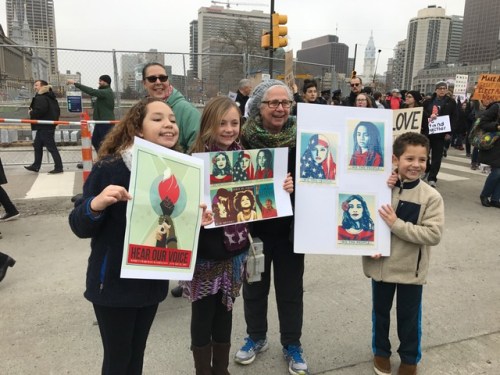
The best thing that happened to me at the Women's March in Philadelphia yesterday was when a couple of young girls, between the ages of 9 and 10 walked with me aways. We had come together because we were carrying similar posters of paintings of "We the People," by Shepard Fairey. As we walked one of the youngest girls said to me: "I can't believe that we still have to do this now." It took me a few seconds to understand that she meant that it was unbelievable that we had to march for women's rights in 2017! I hugged her, and replied, "I know, I know." Such a young girl. Such wisdom. Such understanding.

I realized that after 8 years, after being used to a President, who had our back, who talked to us with intelligence and compassion – there is no turning back. Maybe for a year or two … but no longer. Our youngest children are way too aware. They are not going to take it!

IMG_4541

January-versaries

January is the month my father was born over a hundred years ago. I always think of him around this time each year, and remember his last few days that I spent with him in Zimbabwe at his hospital bedside all the way back in 1980.

January is also the month I started blogging twelve years ago. It opened up the Internet universe for me and I made some good friends – virtual and real. It connected me with people and places all over the world, and opened my eyes to so much more than I could imagine. In December I started a new blog but somehow as I celebrate January – I return to my old blog stomping grounds. I guess I will hang on to both for awhile. 

It is hard to part from this old blog friend that has seen me through so many reflections - has helped me understand the complexity of my feelings - has been a place of comfort when I needed to write about what I was uncovering from my earliest emotional memories. 

I feel like I am surrounded by writing: blogs and book. My mind is forever full of thoughts and ideas, and I find myself scribbling them down on bits of paper just after my shower, or while driving in the car. Life feels full even though I am in phased retirement mode, and am spending more time with my cats than with the world at large. 

Because of the book I am now writing, I am constantly thinking about children needing attention. Today, I thought about how adults want young children to learn self-regulation. Somehow they see children's need for attention as getting in the way of learning self-regulation. Their lessons are so behaviorist in approach: do this and that to please me, your teacher, parent, significant adult – or I will show you how displeased I am. I will ignore you or punish you until you succumb and do it my way. I think to myself, "How will children learn about empathy, compassion, or to make a stand about anything, when they are learning only to please others?" I remember from a very young age learning to do anything for the significant adults in my life just so they wouldn't ignore me. Being ignored makes us invisible when we are children.

How can we learn about who we are or what we need when we are being ignored? Indeed, shunning is so much more powerful even than physical admonishment …

My Fitbit is buzzing and vibrating because all I do is write lately. It tells me to get up and move. I realize as I write this that this is why I love my Fitbit! It relates to me … constantly …